
In my experience, small film festivals geographically far-removed from the US often offer the most thoughtful curation of its cinema. With little, or even zero, pressure to cater to American studios and distributors, their programs function as a more adventurous barometer of the state of the nation than whatever Hollywood deems important enough to share with the public. I approached covering this year’s edition of the Paris-based documentary festival, Cinéma du Réel, with this in mind, excited for and open to unknown gems within its lineup of daring nonfiction cinema. My greatest personal discovery was the feature debut of Armand Yervant Tufenkian, In The Manner of Smoke (2025), a hybrid docufiction of sorts about the narrator’s experience working as a fire lookout in the forests of Central California, near Fresno.
Born to Armenian parents in 1988, Tufenkian completed his undergraduate studies at Colby College, his doctoral studies at Duke, and earned a degree in Film and Fine Arts at the California Institute of the Arts. “One of my teachers had this idea of living your life through cinema, and that really resonated with me,” Tufenkian told me over lunch in Brooklyn in late August. This philosophy of filmmaking—not merely intellectual and emotional, but participatory and immersive—has guided his career from the beginning. Among his adventures, Tufenkian has lived and worked on communal farms in France and Maine, and, like the faceless narrator of Smoke, once spent three summers working as a fire lookout in Central California.
I could scarcely make sense of Smoke as I attempted to think through it in my own writing. I hadn’t encountered a film with as much on its mind in a long time, and was baffled by the ease with which it flitted between various modes of documentation and expression. I’ve continued to think about it since I first saw it in March, not only because it suggested to me an artist of extreme sensitivity and imagination, but because those qualities were so clearly tuned into certain frequencies of contemporary life—chief among them anxiety over ecological disaster, and the fidelity of images and our ability to interpret them—that most films don’t seem to be.
Tufenkian talks often of reverie in relation to this work, and much of Smoke does feel like a dream. Paradoxically, the film achieves a form out of formlessness; separately and simultaneously it resembles a thriller, a process documentary, and an essay about the thrills and dangers of a life fully immersed in any kind of work. In its multimodal way, the film adopts the characteristics of smoke itself, shifting without warning or a discernable pattern, obfuscating what was once clear. To watch Tufenkian’s film is to be taken into his—or his narrator’s—clouded, inconsistent, fanciful subjectivity.
Prior to our wide-ranging conversation about Smoke, I was able to watch the rest of Tufenkian’s films. Most striking among them is Accession (2018), an essayistic, epistolary tribute to seed-sharing and the forgotten corners of rural America, which he made with longtime creative partner Tamer Hassan. Like Smoke, it was conceived of and made with questions of immersion and participation at its center, and sought to answer questions surrounding the representation of experiencing a place, in part, through materiality. Letters, some dating back two hundred years, updating loved ones on their lives and detailing the particular care required for the seeds they sent, are read aloud and indexed in the end credits. Just as meticulously accounted for are the varieties of grainy, scratched, even expired 16mm film stocks the filmmakers used, all specific to each location touched on in the letters.
My conversation with Tufenkian was wide-ranging and comprehensive, focused on locating the threads of his practice both within Smoke and between his whole filmography, and the echoes of paranoia and conspiracy in 21st-Century life. We spoke about his indirect journey to filmmaking; he tapped his fount of literary, cinematic, and artistic references; and he walked me through the realities of immersing oneself in art—and what one can hope to gain from it.
The idea of de-centering the figure or the subject, and centering the ground, or the background, or the envelope around it, was a way to begin creating a structure to represent what the experience of community might be like.
What were your introductions to filmmaking—even before film school—and what were your early ventures in filmmaking?
I feel like I came to it late relative to other filmmakers I’m around now. For a long time I was supposed to go to law school, and when I got to college I started taking philosophy courses and literature courses, and was exposed to all these worlds and discourses and ideas that I found much more interesting than the prospect of making money or going to law school. I took a class freshman year called “Utopia and Dystopia” in the Law, Jurisprudence and Social Thought department at Amherst College, and that class really messed me up in the best possible way. We read a lot of the classics, but also I read Ursula le Guin for the first time, Atwood’s The Handmaid’s Tale, and Neuromancer by William Gibson—all these big texts—and it opened me up to new ways of thinking and being.
I ended up switching to a philosophy and art history major, so my first exposure to film was actually in an art history class, where we watched Running Fence (1977), and Valley Curtain (1974) by the Maysles brothers, for example. The other thing that happened was that in one of my philosophy courses my junior year, the professor said we didn’t have to write a paper, and could do any other sort of project, including a media project. That winter I had done a 24-Hour Film Festival with my friends. We made a short narrative film, which was the most fun thing I’d done in such a long time. So for that course, I ended up making a short documentary with my dear friend, Tamer Hassan, who I’m still making films with today.
One of the guiding preoccupations of In the Manner of Smoke is the idea of provisionality. You mention it in the film’s narration—that what starts as one thing won’t necessarily end its journey in the same form. I wonder if you can pinpoint a time or an experience that made you realize that there was a thing you wanted to make films about, and if that thing has changed?
I recently presented an essay on a film called We by the Armenian filmmaker Artavazd Peleshian. I’ve been grappling with why I’m so drawn to this film, besides the obvious connections to being Armenian, for a long time. I was trying to answer some questions about what community looks like. What is an image of community? This came out of living and working in communes and trying to represent them through film. I was asking myself how I might actually represent it, and whether there is another mode to intimate what it’s like to be in a community. With this essay about the Peleshian film, I felt like I finally understood that it has to do with the structure of the film. The structure contains this appearance, disappearance, delay, return, repetition; it’s constantly moving, and it’s rhythmic, like a temporal-spatial phenomenon. So this question of provisionality, I think, is kind of related to the question of how to represent or intimate the experience of community.
For my film Accession, the question was, how do we literally represent the experience of a place, of being in a place, and of having a connection to that place in a very rooted way? For In the Manner of Smoke, that came out of a conceptual interest in how I might represent the experience of being in this fire lookout alone, and what happens to me in that process. I was driven by the conceptual questions around the relationship between figure and ground, or the relationship between two entities, and how they relate to one another if you’re only focusing on one and not the other.
Tell me about your journey to becoming a fire lookout, and maybe tie that in with your experience of living and working on a commune, as well. Those feel like similar kinds of adventures.
Yeah, they’re definitely adventures. It’s becoming clear that I really need adventure in my life in order to feel alive. Becoming a lookout happened in a really unexpected way, almost. I’d heard about it when I was younger, when I was learning about all the beat poets on the West Coast like Gary Snyder and Philip Whalen, who worked as fire lookouts at some point in their early lives. Jack Kerouac represents that experience in a novel called Desolation Peak, which he wrote while in the lookout, right before he wrote On The Road. So it was all in this moment of prolific production and writing that sounded really romantic to me, and, I guess, was part of the draw to move out to the West Coast at some point in my life.
The summer before I moved to LA to go to CalArts, I was finishing shooting for Accession with Tamer. We were in northern Idaho and it was there that I first saw a forest fire with my own eyes. It was pretty far in the distance, but it was large enough to have an impact on me. I was really awestruck. Later that summer, I stopped in Colorado on my way from Chicago to LA to see some friends, and there was a fire there. When I got to LA a couple weeks later, La Tuna Canyon was on fire and classes were cancelled. Forest fires were just everywhere in my life that summer. It was clearly something that I needed to work with for these reasons, and because I was interested in this idea of Sfumato for several years up until that point.
Can you talk a little bit about Sfumato? You’ve mentioned this particular shading method in painting in other interviews you’ve done around this film, so I’m curious about your interest in it.
I was at the Naropa summer writing program, and one person that I really wanted to do a workshop with was Fred Moten, who I overlapped with at Duke when I was doing my doctoral studies. If you ever meet him you’ll know that he’s a very generous, effusive, lovely human being. And I was complaining to him about my dissertation project on the poetics of community, and he very generously pointed out Sfumato to me in a Robert Duncan poem called The Fire.
I read that last night.
Okay, cool. And so you saw it directly references Piero de Cosimo’s painting The Forest Fire, which is featured at the end of In The Manner of Smoke. I think telling me about Sfumato was Fred’s way of getting me to think about the figure/ground relationship. My question was, “How do you represent community?” The idea of de-centering the figure or the subject, and centering the ground, or the background, or the envelope around it, was a way to begin creating a structure to represent what the experience of community might be like. It also tied into this idea of the Ecotone really nicely, which is where two biological communities meet and overlap. And so all of this is the poetics of relation. How do entities relate to one another? This is the thing that I’ve been obsessed with since I started filmmaking.
Part of what I’ve really enjoyed about watching In the Manner of Smoke is how easy you made it for the viewer to make connections between all the ways of seeing that you’re interested in. But then you set out to problematize all of that by fitting it into a “narrative” structure that defies interpretation. How did you go about creating a logic within the film that balances those qualities?
I’m glad that it makes sense. I’m glad it’s a connectable set of relationships. I think I was ultimately feeling dissatisfied, or felt something was missing, without representing my experience of being in the lookout in some form, which is what the narration became.
You’ve said in other interviews that it was a challenge to either get the narration right or to even include yourself at all.
I was really hesitant to include myself, let alone speak out loud. But I’m always trying to evolve with each project, and I felt like this was the challenge to take on. I could have easily just sat back and kept a distance and made these connections, but I kept asking myself, “What’s my relation? Where am I in all this?” I was trying to figure out a way to compose a text that could somehow be the smoke of my inner world that is constantly shifting, and that also functions poetically in relation to the ideas in the other sections.
What you’re describing is exactly how it felt to read The Fire by Robert Duncan, where these different linguistic forms collide to play with the relation between form and function. Was that poem in some ways a guiding text?
I wouldn’t go so far as saying the poem itself was my main reference. But open field poetry, like the Black Mountain Poets are, I would say, a major reference for me and for my poetry education. I was trying to be in conversation with writers and poets in the way that the text is functioning.
When I found myself in the lookout, for days on end, staring out into the landscape, there was lots of dreaming, lots of fantasizing, leaving the body and projecting onto the landscape.
You quote Fernando Pessoa’s The Book of Disquiet in the film. Can you tell me about your relationship to that text?
That was a major influence on me for this film. I read it multiple times during the pandemic while I was working for this organization that Sean Penn started, called Core. During my off hours, I would go into a section of the San Fernando Park, sit under a tree and read The Book of Disquiet. It’s structured around the everyday experience of an accountant in Lisbon, and I think for this reason it’s often referred to as a true modernist text. It’s about everyday life living in the city, dealing with boredom and lack of connection, and yearning for something greater in life—all things I was going through at the time, having just finished grad school, being in the pandemic moment, and wondering, like so many of us, what was next.
The book begins in this man’s everyday experience of working as an accountant, but then it veers off into this fantasy of what happens when you’re stuck in a job where you have lots of time to sit and do nothing and let your mind wander off. What happens in that space is a question a lot of writers have used to structure their work. When I found myself in the lookout, for days on end, staring out into the landscape, there was lots of dreaming, lots of fantasizing, leaving the body and projecting onto the landscape.
Did you find that was happening unconsciously, or was there a point at which you realized you could, for lack of a better term, make use of this time in some way by intentionally exploring where your mind went in those moments of boredom?
I’d be lying if I said that it was purely intentional from the beginning. I really went into this job as a fire lookout aspirationally. I thought this was going to be my Gary Snyder translating Chinese poetry moment of meditating and coming to these grand realizations about life. And I love staring out onto a landscape—I think a lot of people enjoy that—but at some point very early on, I just found all this shit was coming up, confronting years of unprocessed feelings and ideas just being there by myself. I realized this is part of it.
Is it helpful to process all of that when you’re by yourself, or did it feel kind of like a trap?
It was both. But I think that’s why I was a fire lookout for so many years. I was up there for four seasons and I hadn’t cracked it yet. But I think it takes time to learn how to be up there.
What did you think was on the other side, once you cracked it?
Maybe some realizations, some understandings, which I do think happened.
Any realization specifically?
It’s really cliché, so I hesitate to say it, but it’s this idea of wherever you go, there you are. Obviously I had heard that before, and I’d felt it deeply, and I thought I understood it. But I think I had yet another understanding of it after this project—which was an appreciation for the decision making process we undergo in life and in art.
Did you feel dissatisfied in some way with the decisions you were making around the time you became a fire lookout? This isn’t a therapy session, but I’m interested in getting a clearer picture (laughs).
I was talking with a friend who took time away from writing about and programming films to get a “real,” stable job in an office. I said to him that I think it’s really important for more of us to talk about this with each other, not just amongst friends, but amongst colleagues and people who are in the same kinds of situations. As you know, it’s so difficult to be a filmmaker or an artist in general, let alone in this country. And sometimes I do question my life choices. I’ve made a few films, I have a teaching gig—it’s not a tenure track job, but I make some money—but I don’t know if I’ll ever be able to buy a house, or if I could even afford to have a family. You know, all these things.
After undergrad I was not excited about the prospect of moving to a place where I had to get a nine-to-five job, or going to law school, or anything like that. I was interested in alternative paths, in how other people were living. I discovered all these worlds out there that, to me, were a lot more fulfilling. So sometimes, and during the pandemic, for example, I asked myself, “Do I go back to a kind of communal setting? Do I move to a monastery, or a commune?” I want to hear what you think about this, too, but I feel like it’s unhealthy not to consider alternatives.
It’s fascinating to hear you talk about community and alternative ways of living given that you were so drawn to being a fire lookout, which is an isolated job in more ways than one. But what’s really interesting about your film is that you touch on the various ways that these fire lookouts can maintain some kind of community. There’s a romanticism in how you describe fire lookouts from all over sitting around their radios at night speaking to each other over the airwaves. But your narration also describes being struck by a fear of having to speak in those situations. I’m curious what you were afraid of and if that feeling was true to your own personal experience of being a lookout. Now this really feels like therapy. I promise we’ll get back to form again.
No, no, no, this is super interesting—and more interesting, maybe, than that stuff. I would need to think about that more. I guess what I’ll say is that’s just how I was feeling. I’m also naturally a little shy, or at least a very sensitive person. I don’t really want to take up space. So I guess I was trying to work on that. As for the lookouts, historically, as I understand, they would gather around their radios at night to chew the fat. But being in the situation today, and hearing people on the radio in the Sequoia forest, they’re all so professional. The radio has lost that convivial mode. Now it’s for information transfer, not personal communication. And that distinction is super important because I never felt like I could connect with anybody, even though a human is on the other side. Also, historically, smoke was harnessed to communicate. It was actually a very complex language. And now all that smoke communicates is not harnessed by humans. We’ve lost the complexity of language between ourselves and in relation to nature.
That reminds me of something you say in your narration towards the end of the film, when you talk about secretly wishing that the incoming fire would overtake you. It sounds a little bit like you just wanted something to happen, even if it’s catastrophic or apocalyptic. Does that resonate?
Yeah, totally. Seeing the fire put me into this mode. Maybe I would call it reverie, since there’s a tradition of reverie with fire, but maybe it’s something else—and I have a kind of addendum to that. The idea that if I need the fire in order to be in this mode of reverie, then would I rather not have the fire and not have reverie? Or would I rather have the fire and the reverie, and risk the consequences, and there’s something about—
[At this point a very loud fire engine with its siren blaring had been trying for about thirty seconds to make its way past the traffic outside the, normally quiet, cafe’s outdoor seating area. Tufenkian and I took a minute to pause the conversation and let the sirens die down, chuckling at the coincidence.]
It’s interesting that the sirens came, because there’s this idea of emergency with an uncontrolled fire—which I don’t want to minimize—but there’s something about being put in a position where your life is not guaranteed that forces you to learn things about living in that position. I’m interested in that. I’m interested in control, also. What happens when you give up control in the face of something that is more powerful than you? But anyway, can I tell you the addendum now?
Please.
I make a reference in the film to the meeting of two families: the Tufenkji and the Atash. My last name is Tufenkian and my mom’s last name is Atashian. Tufenk literally means “people of the rifle” in Turkish, and Atash is fire. So, Atashian is “people of the fire” which, for me, connects to this longer Zoroastrian, Pagan, pre-Christian culture that basically worshiped fire and lived in relation to fire in these everyday, but sacred, modes. I guess part of what happens to me in this reverie space is that I’m able to transcend temporal boundaries. That’s the fiction of it—or the belief in something beyond this life—that you can connect to larger scale experiences that relate to fire; and that the fire functions as a kind of index of a larger historical experience coming out of my body. I just wanted to say that, because I don’t think I’ve ever explained that to anybody.
I’m glad you did. I don’t know how I would have wrapped my head around wanting to express all of that in what hopefully resembles an approachable form in the feature film, even if it’s a mixture of modes. Did you feel any pressure to account for everything you were interested in, or did you have to let some things go?
I definitely let a lot go.
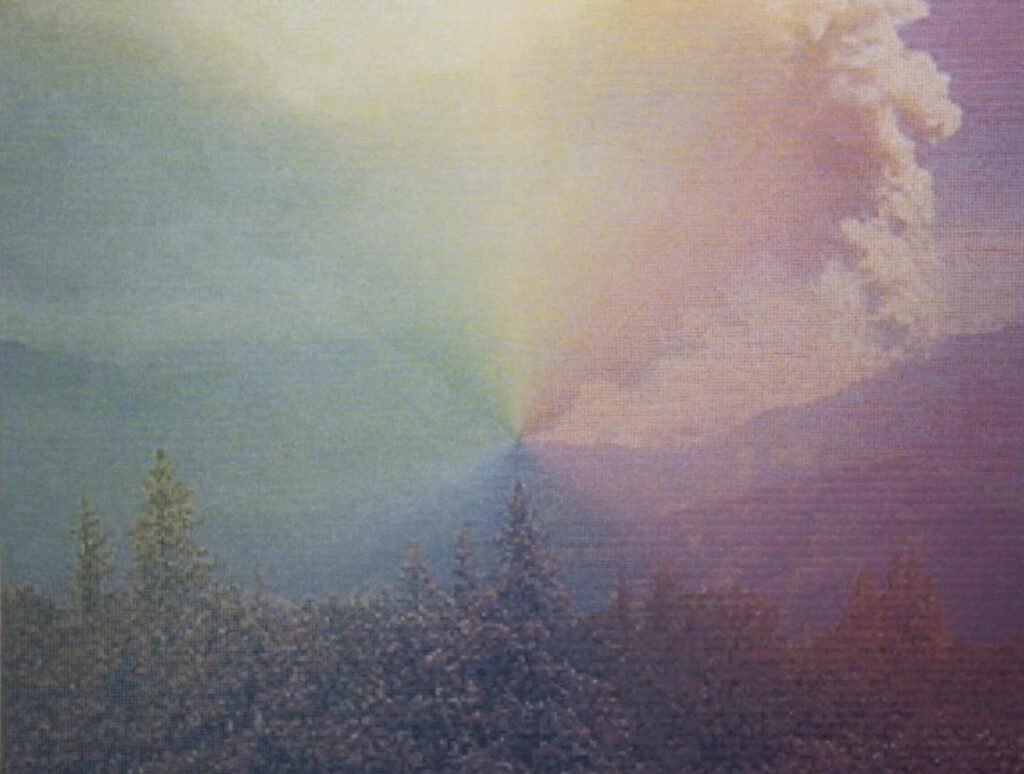
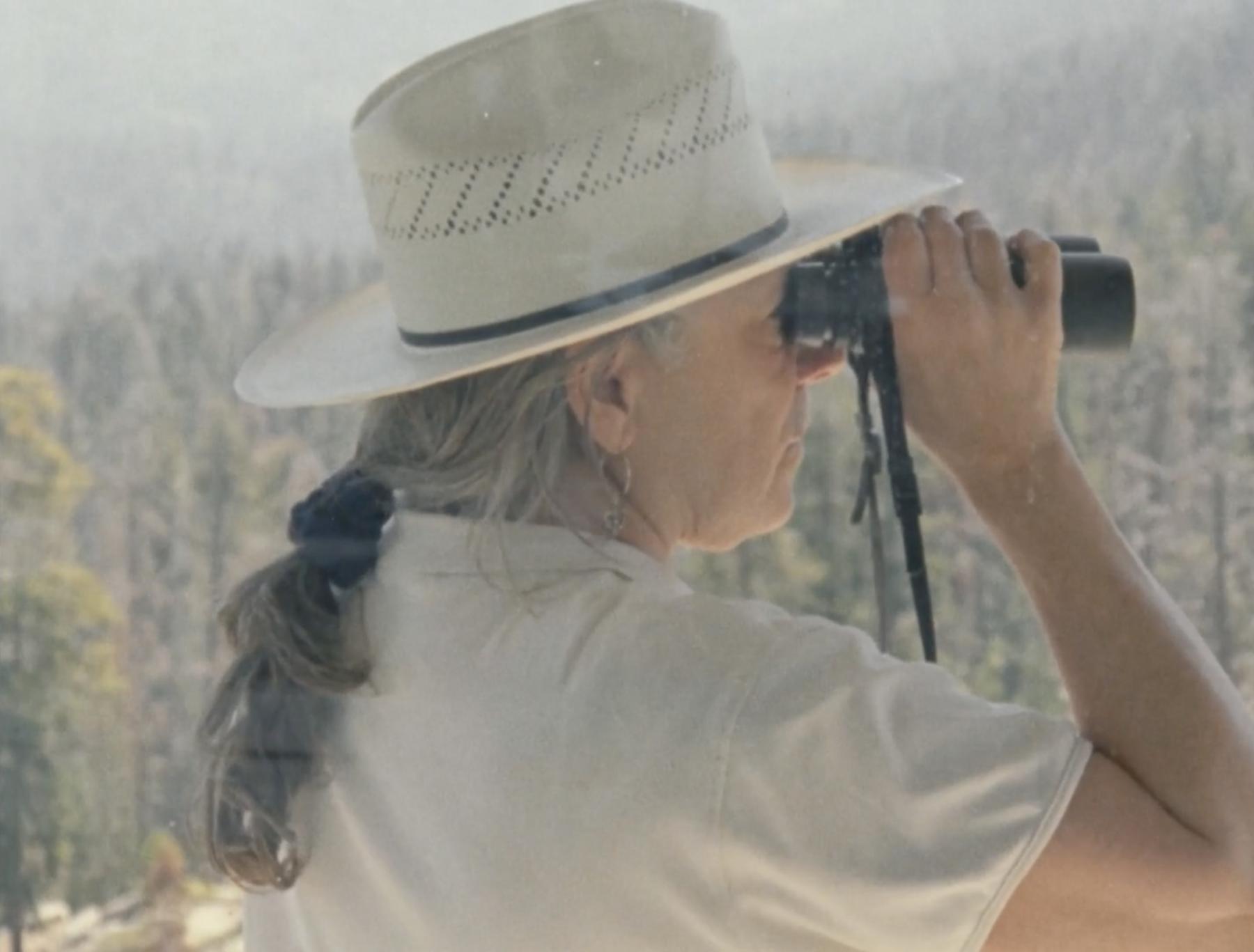
Still from In The Manner of Smoke (2025, Armand Tufenkian)
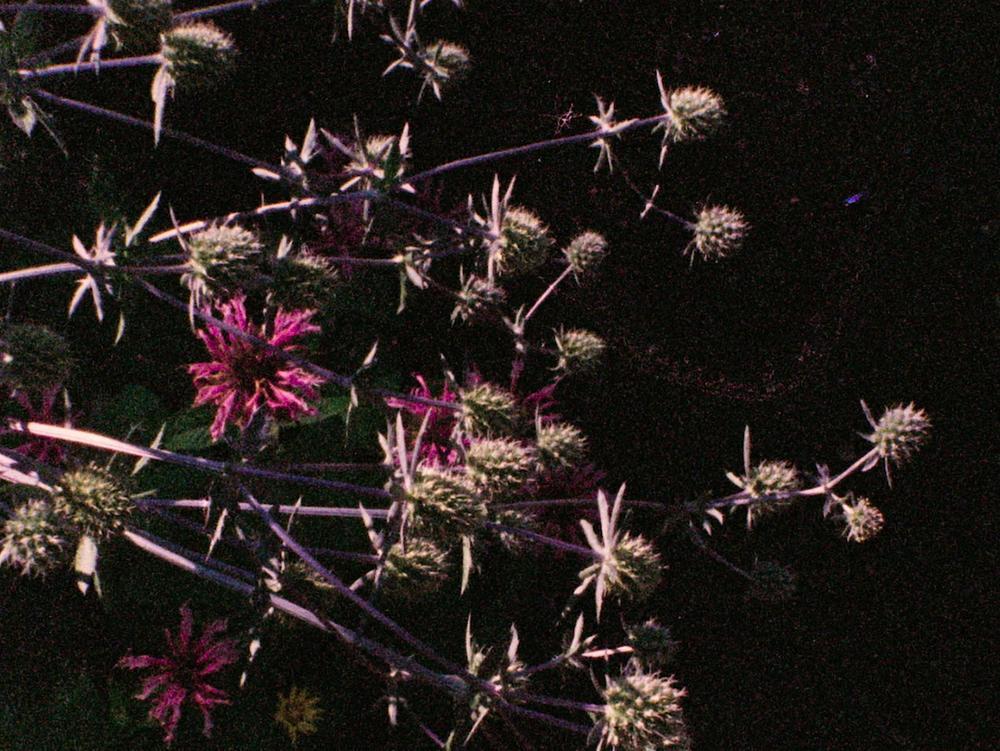
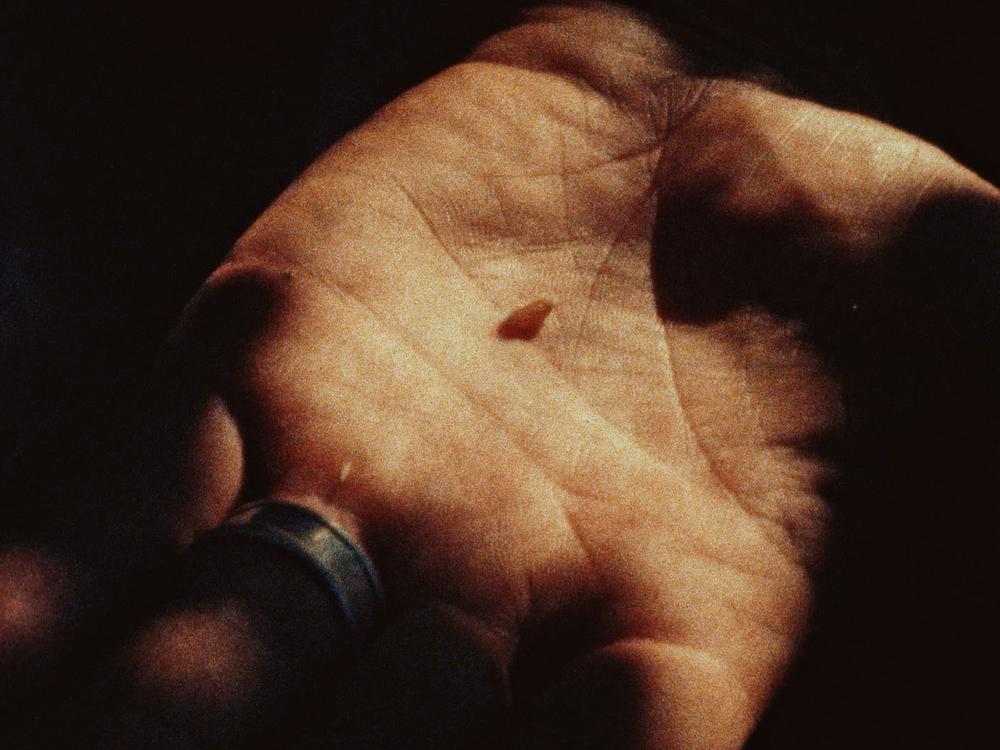
In a previous interview you mentioned a desire to have a section of the film play like a “How-To” for fire lookouts. When we’re watching the fire lookout, Mich, early in the film take atmospheric measurements, are we seeing traces of what that might have been?
Yeah, definitely. The educational potential of cinema is something that I’m curious about myself. I don’t know if you’re familiar with this book called The Process Genre by Salome Skvirsky. In it, she talks about the history of educational films and how that’s morphed into various how-to videos on YouTube, etc. Part of the rationale for me was that I’m learning how to be a lookout, and we need more lookouts in California. In the 1930s and 40s, when the fire lookout position expanded, it was because of the Federal programs that FDR had put in place. It was about expanding jobs for people. I knew that wasn’t going to happen now, but my thinking was, what if we were not a government but a grassroots program where we’re all learning how to read smoke? So many fires are called in by someone just driving on the road and seeing smoke, but what if we actually knew how to read smoke and talk about it so that we can communicate more information and be a part of this bigger network? I thought it would be cool if people watching the film could learn a little bit about how to be a lookout. So that was a part of it. I don’t think I was able to do it in the way that I was interested in, ultimately.
There are so many amazing educational films that they show as part of the lookout training program. I really appreciate how seriously they take their jobs, and I took on that seriousness in a way, and wanted to communicate that.
Over the course of the film, you map this downward spiral from optimistic reveries to outright paranoia, much of which stems from a few theoretical concerns—whether or not we can trust the images in front of us, whether or not we can trust our own eyes, and whether or not the images our eyes see have been mediated or altered by some other thing. I can’t help but feel these are some of the big existential questions of our time right now—increasingly so. Was that something you were conscious of addressing when you were starting this project?
Absolutely. From the beginning I spent a long time asking myself hard questions about why I would shoot this on film, or if I would at all. On one hand, medium specificity is just part of my practice. I have historically shot on film, and maybe I don’t need to justify that. On the other hand, I was considering how it relates to the other questions that I’m asking, and one of them has to do with this huge discourse around indexicality. Not to get super academic on you again, but there is this question—and it’s open ended—about whether we can trust this direct relationship between film and the real. I think film scholars like Tom Gunning, Marianne Doan, and others have written a lot about this to really draw that into question. Can we even say that a film image, a photochemical image, indexes the real? I’m not going to try and answer any of those academic questions, but part of my own set of questions is, why I would shoot on film in the first place. Part of it has to do with the fact that I’m there with it. I can give you the negative. I can prove that I was there. Whereas with a digital image, I could go to great lengths to fabricate the negative that’s purportedly from there. In the story of the film AI fire detection is introduced. In most of California, the majority of human lookouts have been replaced by cameras, and there’s a robust AI detection system that is about to just take over the whole thing. With this looming question of AI detection, I’ve asked myself what gets lost in that process. It’s the human experience. In the times that we’re in right now, that comes with a lot of experiences of paranoia, schizophrenia, and a lot of mental health issues.
The John Smith film The Black Tower is a great reference for this film, particularly the point when I go to Fresno. On one hand, Smith’s film obliterates the subject, the black tower, over the course of the film. But it’s also a great representation of what happens internally, mentally for somebody who’s experiencing paranoia. At the end of the Fresno section in Smoke, there’s a tower that is the source of my, or the narrator’s, paranoia. It says Security Bank on it, and I thought it was a useful, simple representation of the visible regime of capitalism always looming over you.
But even on a more basic level, what happens when you spend a lot of time by yourself, when you hear voices, literally, through the radio, but you don’t interact with anybody? The tether between madness and reason gets thinner. I think that’s a really interesting place of exploration.
There is a moment early in the film, and repeated once later on, in which your fire lookout mentor, Mich, is showing you photographs of the aftermath of the 2015 Rough Fire from various positions in the lookout, and she’s pointing out these small details where there’s lingering damage. Personally, I couldn’t see any differences in the landscape, so there was a tension between trying to take this expert at her word, and trying to put myself in your shoes—as someone who is inexperienced at that point in the film. Even though the photographs showed the aftermath rather than fire itself, it introduced this same dilemma of trusting yourself to accurately interpret an image. I found those two instances where we’re looking at those photographs really interesting and troubling.
It’s interesting that you mention that, because I actually remember doing a lot of double takes at that point in the edit. One of my main interests in filmmaking is asking what the constructs of looking are. I repeat Mich showing the same photographs to point to this potential of performance that’s happening in that moment. And I think that connects nicely to your question about whether that damage was really there. There’s also an insert shot while Mich spins an atmospheric measuring tool around in the air that I used to try to disrupt the mode of real-time, observational documentary that the larger scene was operating in—and point to the artifice or potential of cinema to create something that is not exactly real. It was the same thing with the repetition of the photographs, just trying to double down on that possibility.
I think the historical preservation of symbols is so important, especially in the context of a region that is so marred in conflict, and debates over who is indigenous to which lands. But at the same time, we actually have new ways of looking at things, and if we’re to maintain ways of seeing ornament, we have to imbue them with new meaning.
In the three films you’ve made so far—In Lighting Agnes (2014), Accession, and Smoke—what emerges to me is a very specific interest in observing and participating in other people’s, and other communities’, practices, be they artistic, cultural, or professional. In some ways your artistic practice is to explore other practices, and the form of your films reflects this. Agnes documents a hike up a mountain, and the film stock used for the shoot was processed in the field. In Accession, you participate in the practice of seed sharing and the film itself takes on an epistolary form that mirrors the letters written by those seed sharers. In Smoke, this idea is more abstract, but it’s a film, whose form is always shifting and obfuscating, like smoke itself. Can you speak to this parallel between form and practice?
I appreciate your insight about the thread through those films. I first started taking filmmaking seriously in the context of the communes I lived and worked on at the time. I knew I couldn’t just go to a commune to film and purport to have any sort of accurate representation of the community. One of my teachers had this idea of living your life through cinema, and that really resonated with me. I’m thinking about a film centered on wood, specifically carpentry, so I’m actually looking for a carpentry job right now. So there’s definitely the desire to learn about things through filmmaking.
Then in terms of how that relates to the form—sure, these films have all done that, but now I’m wondering if I need to continue to do that. It’s an interesting point of departure for me because I think there’s a lot of elegance in the way that the form can be refracted through the content.
I would love to know more about your relationship with the artist Dan Hays, who paints landscapes of the forest in your film. How did you get in touch with him?
When I was thinking about Sfumato and Piero di Cosimo’s Forest Fire, I was sure that I somehow needed to include a painter. I was doing research on contemporary landscape painting and I encountered Dan’s Colorado Series, which was created after he contacted another person named Dan Hays, an amateur photographer, and asked if he could use his landscape photographs as source material. So, like the paintings he did for my film, they also have digital artifacts as their origin, interpreted through brushstroke. This was at the same time that I was coming to some conclusions about medium specificity in my own work, like shooting on film; and how I really wanted to engage this question about the digital image, about reliability, and the relationship between the two. When I saw the Colorado Series, I thought it was a really great encapsulation of some of these ways of working.
The first thing Dan told me after we got in touch was that he actually is quite fond of experimental films—his partner is a feminist experimental film historian—and that he would love to see Accession. So, I sent it to him, and he responded very positively. He didn’t know what we would do, but was open to working together, so we just corresponded for about six months. At some point I sent him the entire archive of webcam images from the lookout cameras that are on Delilah—almost 10 years’ worth—not expecting that he would do the same thing he did with the Colorado Series. A couple months passed, and eventually he settled on the Rough Fire and painted a series from that time period. Each painting in the series is done in a different style, which you see in the film, but Dan didn’t even know that that was how I wanted him to approach the paintings. There was this constant reciprocal, very open collaboration.
That must have felt so exciting in the moment.
Yeah, it was amazing. And I feel like it’s not over, I have to say. I would like to do an exhibition version of these projects where you can see the paintings and the film together. The best part of our friendship is we have a shared taste in music, and he listens to music while he paints.
How do you compare the experience of watching someone paint a landscape versus your own experience of looking at the landscape from the perch? Does reverie manifest in a similar way?
Dan’s paintings require him to be 100% present, because they’re so meticulous, so I don’t think he can think about anything else—but maybe he does; I’d like to hear him talk about that. But the experience is very different. I actually loved sitting there watching him, so much more than being in the lookout. It was so rewarding.
The way you shoot his process is really compelling; without having to explain anything you see exactly how he does what he does. For example, seeing which square Dan would decide to paint next, wondering when he’d move back to certain ones he’d passed by. It makes it very pleasurable to watch.
I loved watching that process as well, because sometimes his choices seemed arbitrary. The moment when a new layer is projected onto the canvas and I can see all of the dots or the squares or the lines that he’s going to have to make in advance—there’s a narrative element to it. I guess that’s why I say I don’t know if it’s the last time we’ll work together, because I kind of want to keep doing it.
I couldn’t help but think of Lord of the Rings when I watched your film. I grew up on the books and the films, so the notion of figures who watch over the forest, like the Ents in Tolkien’s books, immediately resonated with me. I was curious if fire lookouts had that romantic view of, or felt there was some sacredness to, the work they do.
Yeah, well, I mean the Ents are my favorite in Lord of the Rings, too. And there are Ents in the Sequoia forest—but they’re the Sequoias themselves, and they’re just as wise as the Ents.
That’s a great distinction. You don’t anthropomorphize them in your film, but the way you talk about them gives the viewer a sense of how they are record keepers and indexers of the forest’s history.
That’s certainly how I relate to the Sequoias. You know, a lot of people that come to the forest and visit the groves of Sequoias that exist now—not to diminish their experience in any way, it’s amazing that those exist and people can see them—but it’s such a paltry iteration of what could be and what once was. Basically, the remaining Sequoias we have are from one generation, and the idea that there were once multiple generations of growth points to the environmentalism of today. I truly believe in an environmentalism that’s seven-generational, which thinks three generations ahead, three generations behind, and also to the current one. Obviously, that’s not the environmentalism that you get with the Democratic Party or Greenpeace, or whatever liberal iteration of environmentalism you want to pick. A friend and mentor of mine, Lee Anne Schmitt has a great film this year called Evidence, and in it she mentions this idea of humility in the face of nature and realizing that we are just this small blip in relation to these larger, complex structures that we’ve managed to somehow convince ourselves are under our control.
Prior to this conversation, you gave me some insight into your next film, about rugs and rug repair. I’m curious to know more about it, now that I’ve been thinking deliberately about how you engage in other practices as a practice of your own.
The project came out of an interest in ornaments. I grew up around them and became desensitized to their presence. One day, I was stretching on a rug in my house, looking down at the design, and had this jarring moment of connection with the ornamental design under me, being reminded of its power once again. There’s this amazing essay called Pleasure For The Eyes by Gini Alhadeff. In it, she writes about her experience of going back to the bazaars in Northern Africa and realizing that she had been suffering from what she calls a “morbus of the eyes”; she had lost the capacity to derive pleasure from seeing those ornamental designs. And so this is all in conversation with Tamer, who actually brought this idea to me in the first place. Basically we’re asking questions around what this “morbus” is, and whether it can be addressed, in part, through cinema.
We hit on this conceptual idea of repair, and then thought about it practically. Rug repair obviously maintains the rugs themselves, but also maintains this way of seeing, makes the material conditions for that possible. We started filming at a rug repair shop in Queens, where people from all over—places like Turkey, Iran, Lebanon, Nepal—work. It was really interesting to be in this space where people are speaking a lot of different languages on the phone with their loved ones back home while they’re speaking in very simple English with each other. Similar to the process of watching someone painting, the process of watching someone repairing a rug is so pleasurable for me, so a lot of the film is just spent watching people do that.
The way that Tamer and I, in different ways and together, approach filmmaking is in this sensory mode. Looking at these rugs, which I think are part of the longer history of ornaments, has a similar potential for drawing you in that we find in the camera’s viewfinder, taking you into this mode of being and seeing that is outside the regular world. We’re interested in what happens during this trance-like experience, what role language has in it, what role interpretation plays in a sensory experience with an ornamental object, and whether it’s important.
We got into this debate over the importance of the historical preservation of symbols and their meanings against, or alongside, the importance of a sensory experience of symbols—which could be interpreted as ahistorical—and the potential in giving them new meaning today. I think the historical preservation of symbols is so important, especially in the context of a region that is so marred in conflict, and debates over who is indigenous to which lands. But at the same time, we actually have new ways of looking at things, and if we’re to maintain ways of seeing ornament, we have to imbue them with new meaning.
- The above conversation was conducted by Chris Cassingham, a writer and critic based in Brooklyn.
Editorial support by Hannah Bullock.
Cover image: Still from In The Manner of Smoke (2025, Armand Tufenkian)